

Visa Mobile Payments Announcement Coming Next Week

Visa CEO Joseph Saunders has just let loose that the company will be unveiling its mobile payments strategy as soon as next week. The mobile payments space is still a hazy area that many large companies are just beginning to explore. But generally the goal seems to be to replace consumer wallets with mobile devices for making purchases and then get control of that payment network to monetize it via transaction fees or advertising partnerships. It’s hard to predict what Visa’s strategy for mobile payments will be as they’ve remained quite mum about it. But they have been heavily pouring money into the space, recently investing in Square, the mobile merchant services company, whose device lets customers accept credit card payments via their smartphones. They also partnered with Gap in a program that alerts customers of discounts on jeans and apparel via text messages when the customer is in the vicinity of a Gap retail store.
“We’ve been reluctant to talk about it until we have put together…an appropriate [response], where we can tell you something positive and significant,” said Saunders. He also believes that for their strategy to be viable, it must address five characteristics: Convenience and simplicity, standardization, interoperability, global accessibility, and security.
“None of the solutions we have seen from competitors is comprehensive enough because they don’t address all of these criteria at once. Visa has long delivered solutions at the physical point of sale that passed this test and we are applying the same standard in the online and mobile arena,”
This feels a bit like a slap to the face for the competing ISIS mobile payment venture formed by AT&T, T-Mobile, and Verizon. ISIS started off with bold claims to completely replace credit card networks with their own mobile payment network, but recently scaled back those ambitions. Another contender in the space, but with a more modest approach, is Google, who has already deployed trial programs for NFC-based Places and coupons.
Labels: Mobile, Mobile Phone
IDC: Smartphone shipments up 80 percent in last year

In the first quarter of 2011, smartphone shipments were up 79.7 percent worldwide compared to 2010.
Nokia X7
Market analysis firm IDC pas published its Worldwide Quarterly Mobile Phone Tracker data for the first quarter of 2011, and the results show consumers are jumping on the smartphone bandwagon like never before. According to IDC, worldwide sales of smartphones reached 99.6 million units during the first quarter of the year, a 79.7 percent increase over the 55.4 million units shipped in the same quarter a year ago. The reasons? Consumer demand, of course, fueled by both the availability of highly-anticipated new devices along with lower price points for older or basic smartphones that let users get their foot in the door.
“The rise of Android as a prominent mobile operating system has allowed several suppliers to gain share quickly,” adds IDC senior research analyst Kevin Restivo, in a statement. “Also, the relatively nascent state of smartphone adoption globally means there is ample room for several suppliers to comfortably co-exist, at least for the short term.”
IDC still pegs Nokia as the largest maker smartphones on the planet—this despite largely ignoring the North American market and still struggling to come up with a response to Apple’s industry-changing iPhone. According to IDC, Nokia still accounted for 24.3 percent of the global smartphone market in the first quarter of 2011—and while that figure represents a 12.6 increase over the company’s shipments a year ago, it’s well behind the overall growth rate of the smartphone market. IDC ranked Apple as the number-two smartphone vendor with an 18.7 percent share during the first quarter of the year; Canada’s Research in Motion came in third with a 14 percent share, Samsung managed fourth place with a 10.8 percent share, and HTC came in fifth with an 8.9 percent share.
Although Apple posted very strong growth for the quarter—moving within 6 million units of Nokia—the strongest growth was actually seen by Samsung, which saw a 350 percent year-on-year increase in smartphone shipments, riding the success of its high-end Galaxy S smartphone line along with Galaxy Ace and Galaxy Mini devices at lower price points. And, although it’s not available in the North American market, smartphones running Samsung’s Bada operating system continue to do good business.
Labels: Mobile, Mobile Phone
O2 XDA Zinc Mobile Phone
 The O2 XDA Zinc is the next in the series of O2 XDA Smartphones which are starting to make a name for themselves in the smartphone market. Sleek, easy to use with an impressive polished finish, the handset looks the part and holds a vast array of the latest services required for a life on the move.
The O2 XDA Zinc combines a traditional Mobile Phone offering with the latest PDA technology, and is sure to attract users from the business and personal use markets. Considering that the O2 XDA Zinc offers a PDA service, the dimensions of 110 mm x 59 mm x 21 mm, and total weight of 170 grams are fairly impressive. The battery power and standby statistics are not yet available, but will be released on launch (first quarter 2007). The mobile contains a standard PC QWERTY keyboard, which is hidden behind the front screen, and is accessed with an impressive horizontal slider system.
The phone itself is dominated by the front display screen which is 2.8 inches in diameter, offering 240 x 320 pixel resolution, and up to 65,000 colour combinations. The touch sensitive screen is very useful for the more traditional phone functions, used in conjunction with the basic keys situated on the front of the handset. The O2 XDA Zinc covers the latest of network formats including Tri-band (GSM900, GSM 1800 and GSM 1900), together with the latest roam capability, UMTS.
The phone has a CMOS digital camera, which as well as offering the traditional still picture and video clips software, supports the ever popular video conferencing facility. It also offers the full range of messaging facilities, such as SMS, MMS, Picture messaging, Instant Messaging and email (supported WAP internet access). The array of connectivity options is just as impressive including, 3G, Bluetooth, WLAN, GPRS, EDGE, Infra Red and USB cable connector.
The above facilities of the O2 XDA Zinc are complimented by the PDA options including extended phonebook, calendar, calculator, clock, alarm clock, task manager and notes system to name but a few. While the model is a little larger than your standard mobile phone, the O2 XDA Zinc smartphone really does offer a great system for the business person on the move, a system which is fully compatible with today’s PC systems, with the connectivity options to allow instant data transfer.
In an ever more crowded smartphone market, the O2 XDA range has created a presence already and is proving very popular.
Labels: Mobile Phone, O2, Smartphone
The O2 XDA Trion mobile phone at the Carphone Warehouse
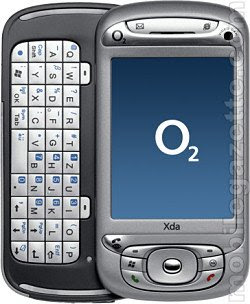
This is the O2 XDA Trion mobile phone a sharp and stylishly designed mobile in stunning silver with one of the best brains you can find and backed by Windows Mobile 5.0 which allows you to view and edit Microsoft Word and Excel documents and check out PowerPoint presentations, and the use of WiFi and 3G keeps you in control.
The O2 XDA Trion has a large touch screen which provides access to all its features; however you will also find that the Trion has a slide out QWERTY keyboard as well as a 2 megapixel camera, media player, expandable memory, Bluetooth connectivity, and quad-band coverage.

You can acquire the O2 XDA Trion mobile phone from the Carphone Warehouse as they have it with the O2 network on a tariff of O2 - £35 – 18 months, 600 minutes and 500 texts per month, and 512kKB inclusive browsing.
Roughly speaking, the O2 XDA Trion is a step up from the O2 XDA Mini S (based on the HTC Wizard). It has a 240x320 pixel display in 65,000 colours, a 2 megapixel main camera with a secondary camera for video calling, 64Mb of internal memory, Bluetooth 2.0 and Wireless LAN support and a 400MHz processor (possibly an ARM-based Samsung S3C2440). There's a slide-out keyboard too (the photograph is of a German QWERTZ keyboard). The weight is not known, but we anticipate that it will be about 160 grams. We believe that the Hermes used microSD expandable memory.
* WAP
* Bluetooth
* 3G
* Faster data with GPRS
* Camera phone
* Music player
* World phone (Quad-band)
* Colour screen
* Picture messaging
Labels: Mobile Phone, O2
The O2 XDA Stealth Mobile Phone

The O2 XDA Stealth : Review
The O2 XDA Stealth offers another option for those who want a Windows Mobile / pocket pc phone. So far Windows Mobile phones had either a sliding QWERTY keyboard (HTC TyTN, i-mate k-JAM, i-mate JasJar etc), or a QWERTY keyboard on the front (HP IPAQ hw6515, hw6915, Motorola Moto Q, UBIQUIO 501 etc), or no physical keyboard at all (i-mate JAM,i-mate JAMin, O2 Atom etc). The O2 XDA Stealth was made for those who like the “traditional” phone design with the sliding number keypad but powered with Windows Mobile 5.0. The device does not offer any special connectivity options like 3G or built in GPS but it does have built-in Wi-FI and Bluetooth. The physical dimensions of O2 XDA Stealth can be compared with most Nokia and Sony Ericsson models and thus making the device attractive for the “normal” mobile phone users. The combination of design and Windows Mobile features can also satisfy the needs of the demanding windows mobile user.
O2 XDA Stealth Design
The O2 XDA Stealth looks like a “regular” phone. The lack of a QWERTY keyboard and the sliding keypad makes you think that it is another Symbian phone. When you power on the phone you start to realize that behind the O2 brand is another Windows Mobile Pocket PC Phone. The O2 XDA Stealth is running Windows Mobile 5.0 Phone Edition. The display is a touch panel and there is a stylus for performing all PDA functionality, as you do on any other pocket pc.
The size of this device is 110 x 53 x 22.5 mm. This is slightly bigger (smaller in width) compared to O2 Atom Exec but smaller than the HTC TyTN. The weight is 140g, which is the same as O2 Atom Exec but lighter than HTC TyTN (176g) and ASUS P525 (160g).The display is 2.4 inch, with 320X240 resolution. On the front and below the touch panel, there are the selection buttons, calling buttons and a four way directional pad with a small enter key in the middle. When you slide open the phone you will see the keypad with the dialing buttons set in the standard way, the same as you find on all regular phones. At the bottom of the phone there is a USB socket used for PC synchronization and for charging. Next to the USB you can find the stylus.


O2 XDA Stealth Features
The Xda Stealth is a tri-band (GSM900/1800/1900) phone with 192MB of flash ROM and 64MB of RAM. In terms of expansion there is a miniSD card slot (located on the side). The processor is Intel XScale at 416Mhz. For connectivity the O2 XDA Stealth offers built-in Wi-Fi 802.11b/g as well as Bluetooth. The camera is at 2 mega-pixels and it is located on the rear. It should be noted that the Stealth has no 3G Capabilities. Compared to the other 3 devices, HTC TyTN, ASUS P525 and O2 Atom Exec the Stealth does not have infrared but the ROM of 192 MB is bigger than the 128 MB of TyTN and ASUS P525.
In terms of Software, the Xda Stealth runs on Windows Mobile 5.0, with capabilities for push e-mail, MS Office Mobile (word, excel) and Web browsing in other words all the usual applications that come bundled with Microsoft Windows Mobile. In addition the O2 XDA Stealth has software that simulates a virtual answering machine. You can use these features to record a message that people that dial you will hear when your phone is busy.
O2 XDA Stealth Performance
To analyze the performance of O2 XDA Stealth we concentrate on these 4 important factors: processor speed, phone functionality, battery life and camera quality.
Processor Speed: The O2 XDA Stealth has an Intel Xscale PXA272 processor running at 416 MHz. This alone makes you except that the performance of the device will be good. After experimenting and working with the phone for a few days we can state that the performance of this device is good and above average level. In fact it performs better than the TyTN. The respond of the O2 XDA Stealth to running programs and switching between running applications is excellent.
Phone functionality: The signal strength / reception is not the best you can find but is not that bad (the signal strength depends on the carrier you’re a subscriber). Compared to HTC TyTN we found that the TyTN had better reception under the same conditions and using the same carrier. The quality of audio during calls is good but the maximum volume for the earpiece could be better.
In terms of connectivity we noted before that the device is only tri-band GSM with lack of support for EDGE and 3G.
Camera: The camera is activated by pressing the dedicated button on the O2 XDA Stealth’s left side. The camera is at 2 mega pixels with Auto Focus and Flash. The quality of the pictures is better that what we expected to find on a 2 mega-pixel camera. The presence of flash makes night time pictures to look good especially when they are viewed on a PC.
Battery Life: The O2 XDA Stealth has a lithium polymer battery and according to official O2 the battery has up to 4.5 hours talk time and 150 hours standby time. Translating that to plain words with average use and having wi-fi and bluetooth turned off you will need to charge the device every other day.
Labels: Mobile Phone, O2
O2 XDA Orion Mobile Phone

The O2 XDA Orion mobile phone was released earlier this year and works with Quad-band GSM networks. The phone weighs close to 106 grams and measures approximately 107.5 x 46 x 17.5 mm. The O2 XDA Orion mobile phone comes with a good 65k color TFT screen with a display resolution of 240 x 320 pixels. The screen measures about 34 x 45mm in size.
The O2 XDA Orion mobile phone comes with a miniSD card slot with 64 mb of SDRAM and 64mb of Flash ROM too. The phone runs on a Windows Mobile 5.0 operating system, and is powered with a TI OMAP 850, 200 MHz processor. One of the best features of the O2 XDA Orion mobile phone is the Wi-Fi 802.11b network which is supported by the phone. There are also other high speed data networks which are supported by the phone like GPRS and EDGE. With the phone there comes a good 1.3 megapixel camera which can take still pictures at 1280 x 960 pixels and videos at VGA resolution. The O2 XDA Orion mobile phone has other additional features like a Mp3/AAC player, Java MIDP 2.0, and a built-in handsfree.
The O2 XDA Orion mobile phone has a battery life of about 4 hours talktime and 160 + hours of standby which isn’t great by any standards.
Labels: Mobile Phone, O2
LionKing800 Mobile Phone Boasts One Year Standby? Hmmm

We’ve seen some handset manufacturers take a few liberties here and there, but at least they typically try to issue specs that bear some semblance of reality. Sometimes however, you skip past a gem that warrants a double-take, a snicker and a few solid minutes of pointing and laughing. Take the LionKing800 for example. Moving past the fact that if this device was built by any credible manufacturer they would have a hell of a lawsuit on their hands, why would anyone try to pass off a handset as having a full year of standby time? Yes, the 16,800 mAh battery is absolutely gigantic but no, it certainly won’t provide 3 - 5 days of talk time and 365 days of standby time
Now that we’ve cleared the air, the device itself is actually kind of badass. In fact, if it was quad-band we might even snag a few to play with. Spec highlight time:
* Dual SIM slots
* MicroSD support
* Bluetooth 2.0
* 3.5" Touchscreen with handwriting recognition
* Four speakers
* "16,800 mAh battery super long standby"
* MP3, MP4 support
* e-book reader
Spec lowlight time:
* 265K color screen
* Dual 0.3 megapixel cameras
* GSM900 / DCS1800
* GPRS only
Ok, so which brave soul is going to order one to play with? Entrance fee: $145 and cahones of steel.
Labels: Mobile Phone